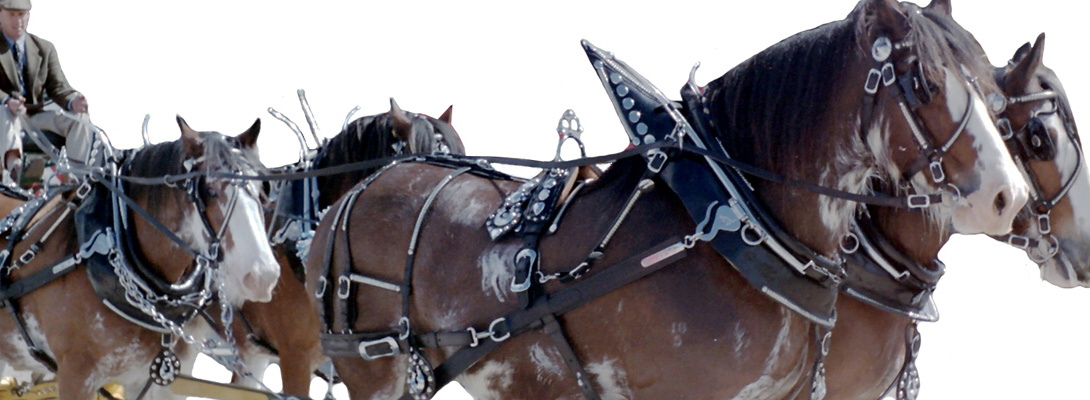
Collars
Traditional Australian long-straw collars are hand-made, and stuffed with rye-straw. The straw for both the rim and the body is long, not chaff as used in machine-stuffed collars. The long straw enables much firmer collars to be made than the mass-produced, chaff-filled versions. Besides lasting many times longer, the long-straw collar also enables the horse to pull a heavier load with the minimum of discomfort to it, without the need for a collar pad.
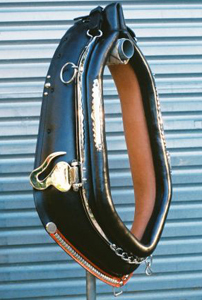
The heaviest of the traditional Australian collars is the Dray Collar, with the 'Double rim' or 'Ballarat-style' Dray Collar [pictured below] being the heaviest-duty of all (with an additional layer of leather to protect the channel from the hames, & extra-heavy side-pieces).
The next size down-for standard draught work - is the Draught Collar, followed by the Plough - for light draught work. Many of the brewery show teams today prefer this weight of collar [in larger sizes, of course, to fit their show horses] to 'show off' more of their horses' necks in the ring, or out on parade.
Delivery or Cart Collars are smaller again in the body and rim, and come in either medium or light delivery versions, for half-or-quarter-draughts.
For light horses, the heaviest type of traditional Australian collar is the Coach, followed by the Sulky/Buggy/Jinker Collar, and with the Pony Collar the lightest of all.
Most Australian collars are made open-topped, with a [steel] pipe-iron placed inside the throat of the rim to strengthen it so that the collar can be opened under the horse's neck to get it on and off (rather than having to be put on over the horse's head). Close-topped collars can, of course, be made if required.
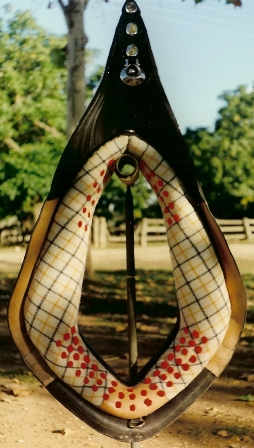
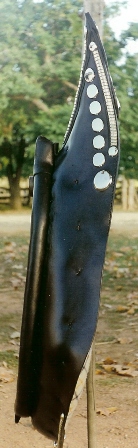
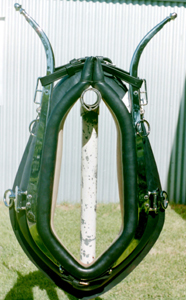
An unusual, uniquely-Australian collar is the Bronco Collar, traditionally used in the unfenced Outback for pulling cattle up to a 'Bronco Panel/Ramp' for branding, marking, etc. It is similar in appearance to a Draught or Plough Collar, but with much shorter 'ears', & with quilting in the throat for additional strength here. (see photos below)
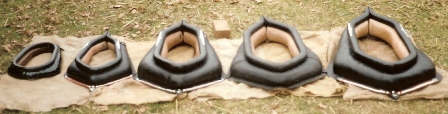
From pony through to dray size

Patent leather coach (show), with brassed hames

English style, close-topped coach (show) with red patent piping

Dress coach

Dress light delivery / cart
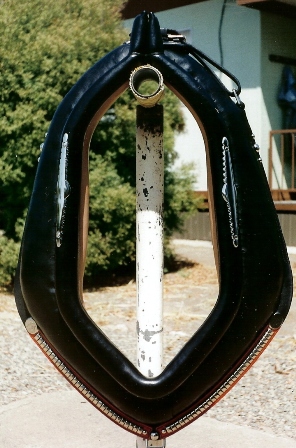

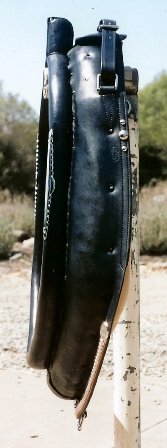
Show light draught

Show dray collar
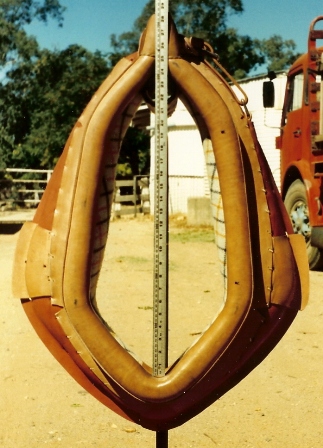
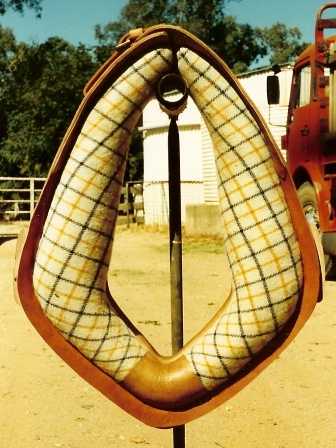

Work 'Double rim' or 'Ballarat-style' Dray collar
SCOTCH COLLARS (SHOW)


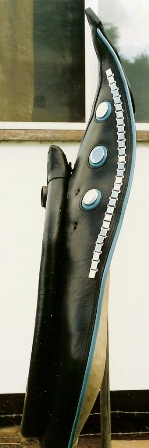
Close-sided, with piping
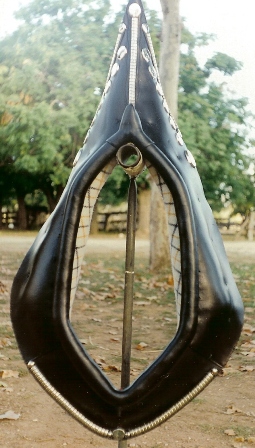
Open-sided
CAMEL COLLARS
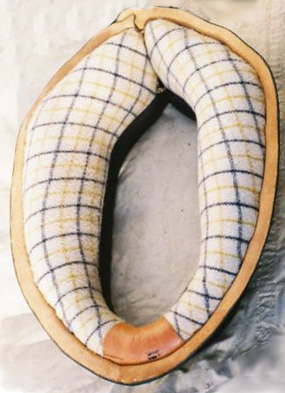


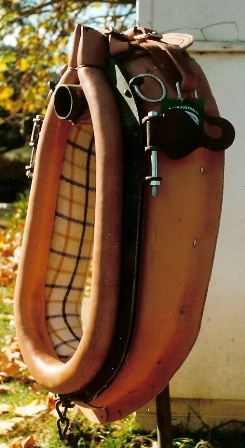
BRONCO COLLARS


MINIATURE COLLARS


Mini-Dray


Mini-Camel
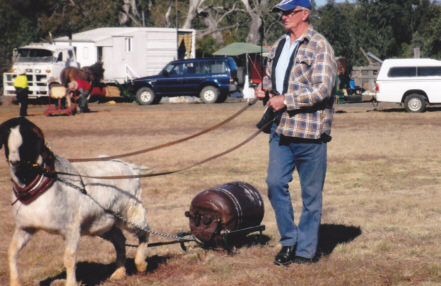
GOAT COLLARS

WINKERS
Many different styles of winker [blinker], and winker eye shape, can be made. The following photos show examples of some of these styles, for both heavy and light horses.
SHOW WINKERS


Melbourne-style, sensible-eye, split-cheek: Red patent piping & box loops (Draught winkers)

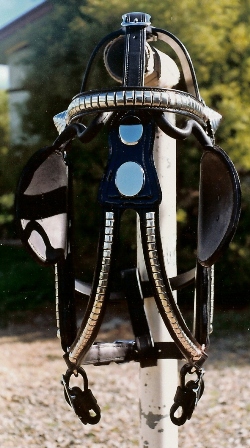
Melbourne-style, sensible-eye, split-cheek: Black patent only & standard loops (Draught winkers)
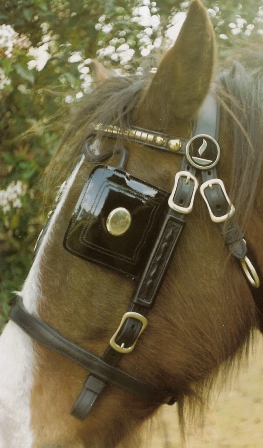
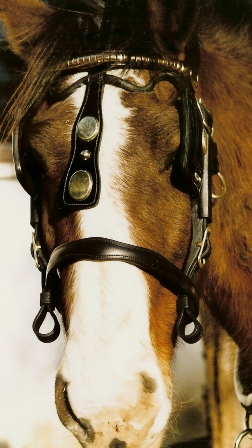
Square Eye, Fixed Cheek Style (Coach winkers)
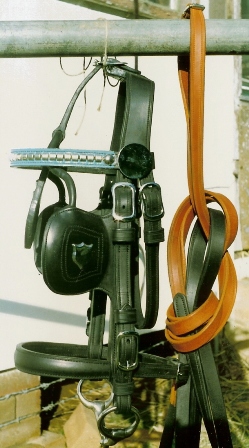
Sensible- Eye, Independent Cheek Style (Pony winkers)
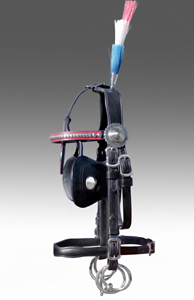
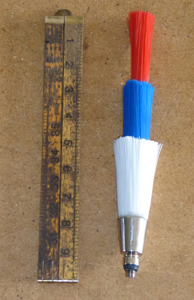
All Show Draught Winkers are supplied with a plume as pictured here on these draught sensible eye independent cheek winkers
DRESS WINKERS
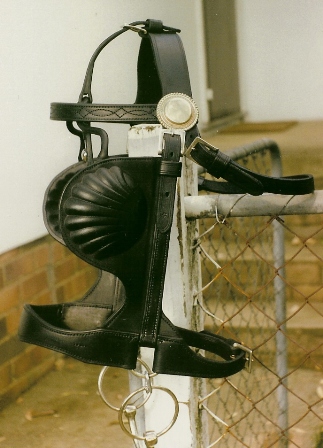

Shell-Eye

Dolly Varden
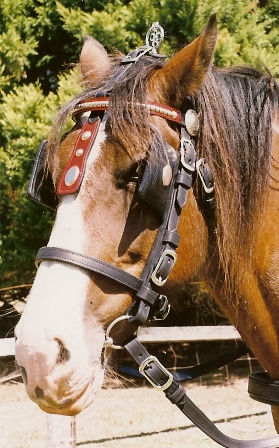
Square Eye (Sulky/jinker winkers)
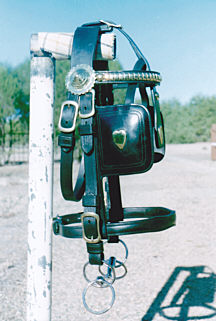
Square Eye (Draught winkers)

Sensible Eye (fixed cheek)
WORK WINKERS


Sensible-Eye, Independent-cheek style (Draught Winkers)

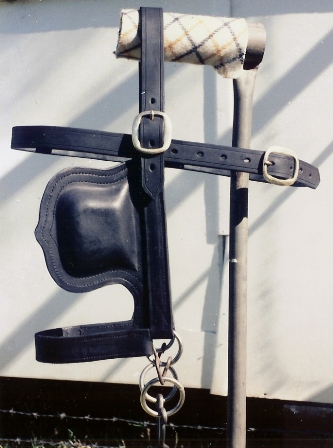

Work Plough Winkers: (a) Shell eye (b) Block eye (c) Dolly-varden
More Products from Asterisk Horse-Collars & Harness
DRAUGHT SHOW BRIDLE & LEAD
The Draught Show Bridle is intended for use on mares in led classes. The Lead pictured is the double-billeted version; a single-billeted lead is also available.

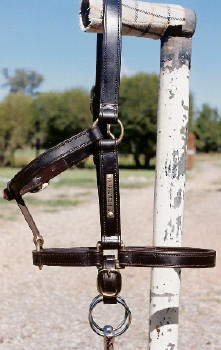
DRAUGHT HEADSTALL (DRESS)
The Draught Headstall pictured [normally made without the name plate] is for showing younger horses in led classes.

STALLION ROLLERS (SHOW)
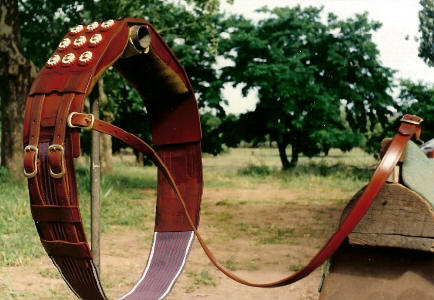
Asterisk Horse-collars & Harness manufactures three different styles of Draught Stallion Roller:
Australian-style Stallion Rollers [see photos below]:
Traditionally, this style has a leather roller-top, with a webbing girth (colours now available are red/white/gold or blue/white/gold) and a single, off-side side rein. This style can also be made with a matching leather girth.



English-style Stallion Rollers: [see photos below]:
This style is usually made with a special narrower, royal blue and white webbing roller top and girth, and normally comes with a backstrap/folded dock and a headcheck, as well as side-reins.


Scottish-style Stallion Rollers::
This style is traditionally made in Scotland and Northern England with a 'Scotch Top' or buckle-on rosette pad, with the rosettes made of intricately woven ribbon [see first close-up photo below], with both ribbons and webbing again in the royal blue and white colours. A less expensive version to that pictured can be made from royal blue and white patent [see second close-up photo below].
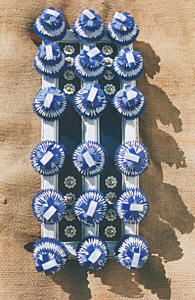
Ribbon rosettes

Patent rosettes

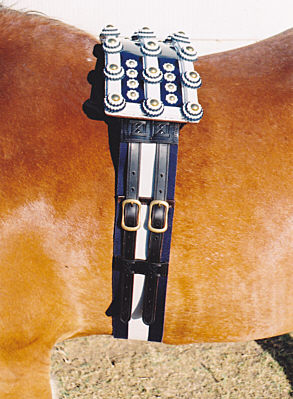
STALLION HEADSTALL (SHOW)
The Draught Stallion Headstall pictured below is much more ornate and substantial than the Dress Headstall previously shown, with heavy brass hardware and strapping as appropriate for showing a draught stallion.
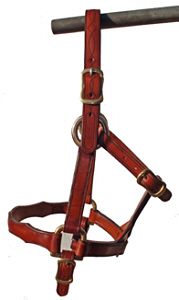

STALLION BRIDLE(SHOW)


DRAUGHT NOSEBAG (SHOW)
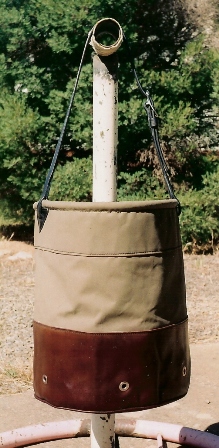

DRAUGHT SPAT BOOTS
The Spat Boots (normally made from harness leather, rather than the white-hide in the photo below) come in two sizes; Full and Yearling/Two-Year-Old.

DRAUGHT HOBBLES & HOBBLE CHAINS

DRAUGHT KNEE-HOBBLES
To make a horse stand

DRAUGHT BREAKING IN BRIDLE / ROLLER / CRUPPER / SIDE REINS

CAMEL PACK SADDLE


WIGRAM PATENT CART SADDLE
The Wigram Patent Cart/Lorry Saddle is made with a pressed steel, rather than leather, housen, for the budget-conscious heavy horse enthusiast. This style of saddle is normally made with a check-lined panel, which is firmly straw-stuffed [to the traditional saddle standard] to ensure the comfort of the horse. The photo below shows such a saddle, mounted with the backband and shaft tugs.
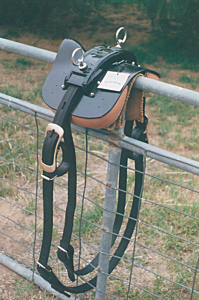
TRADITIONAL CART/LORRY SADDLE
The photo below shows a standard Square Cart/Lorry Saddle (Work, leather-lined panel), with the traditional leather housen.
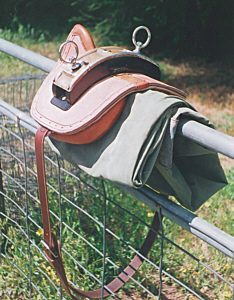
NECK BAGS
The photos below show examples of a set of Neck-Bags, with concertina gussets, made to be secured to the front of a riding saddle
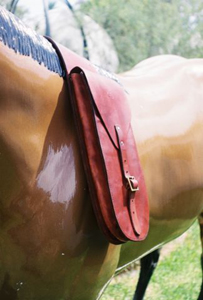

CART LOCK-STRAP
The photo below shows a Cart Lock-Strap, which is used –in combination with the reins – to ‘lock up’ a horse in a two-wheeled vehicle parked by the road-side

Hame Types
Pressed steel Draught Hames are made in a number of different styles. The photo below shows a set of Single-horse, long-topped Show hames with acorn knob-tops, and twisted link chain which fits snugly under the rim at the bottom of the collar. Ensure that the twisted links are laid flat prior to fitting the hames to the collar. Please note the correct location of the hame strap when done up correctly; ie. a convex shape, not straight across.

In the photo below, another type of Draught Show Hames is pictured - again, for a Single-horse. These have hame strap lugs at the bottom instead of twisted link chain. The top hame strap is normally left done up and the hames are put on and removed via the bottom strap.

The photo pictured below shows yet another style of pressed steel hames, the ‘Orchard-style’ or – in this case – Brake Hames, again for a single-horse. Pair/Team Show Draught Hames have Pole-chain Dees added if required.
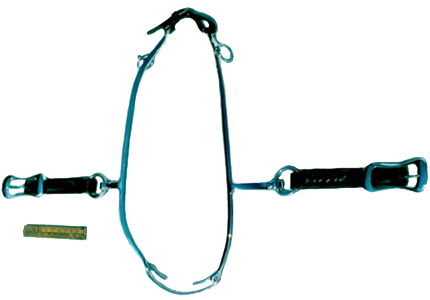
Delivery Hames: The hames pictured below are Delivery Hames, made from solid bar, with standard spurs, loose-ring draught (with the hame tugs – with box loops – sewn in), loose rein rings and a kidney link at the bottom. Often, these hames are made with hame strap lugs on both the bottom and the top.
Coach Hames: The hames in the photo below are Pair Coach Hames (Show, brass-plated, scroll-draught (with hame-tug clips) and with a kidney link at the bottom

Modified Dray Hames: The hames in the photos below are modified Dray Hames [with most of the tug chain removed], with the unique closed-hook/ring arrangement ready for attaching leather traces for show.
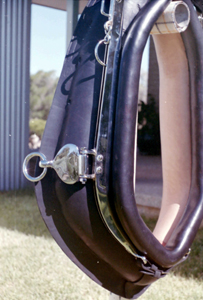
Close up of Hame Tugs with Box Loops

Housens
The original purpose of a housen was to run the rain/drizzle off the horse’s neck when having to work in these conditions (it was laid down flatter for this purpose on the top of the collar). Nowadays, the purpose of a housen is purely for show, and one is often used to advertise a business or stud


Rear of a housen, showing the frills & housen strap.